
DBPilot
Self-hosted database performance diagnostics for SQL Server, MySQL & PostgreSQL: trends, AAS insight, Top SQL, plan-change tracking, blocking & deadlock analysis. Single-process deploy, built-in MCP server for AI agents.
Links
README
From the repo.
DBPilot
Self-hosted database autonomous diagnostics platform.





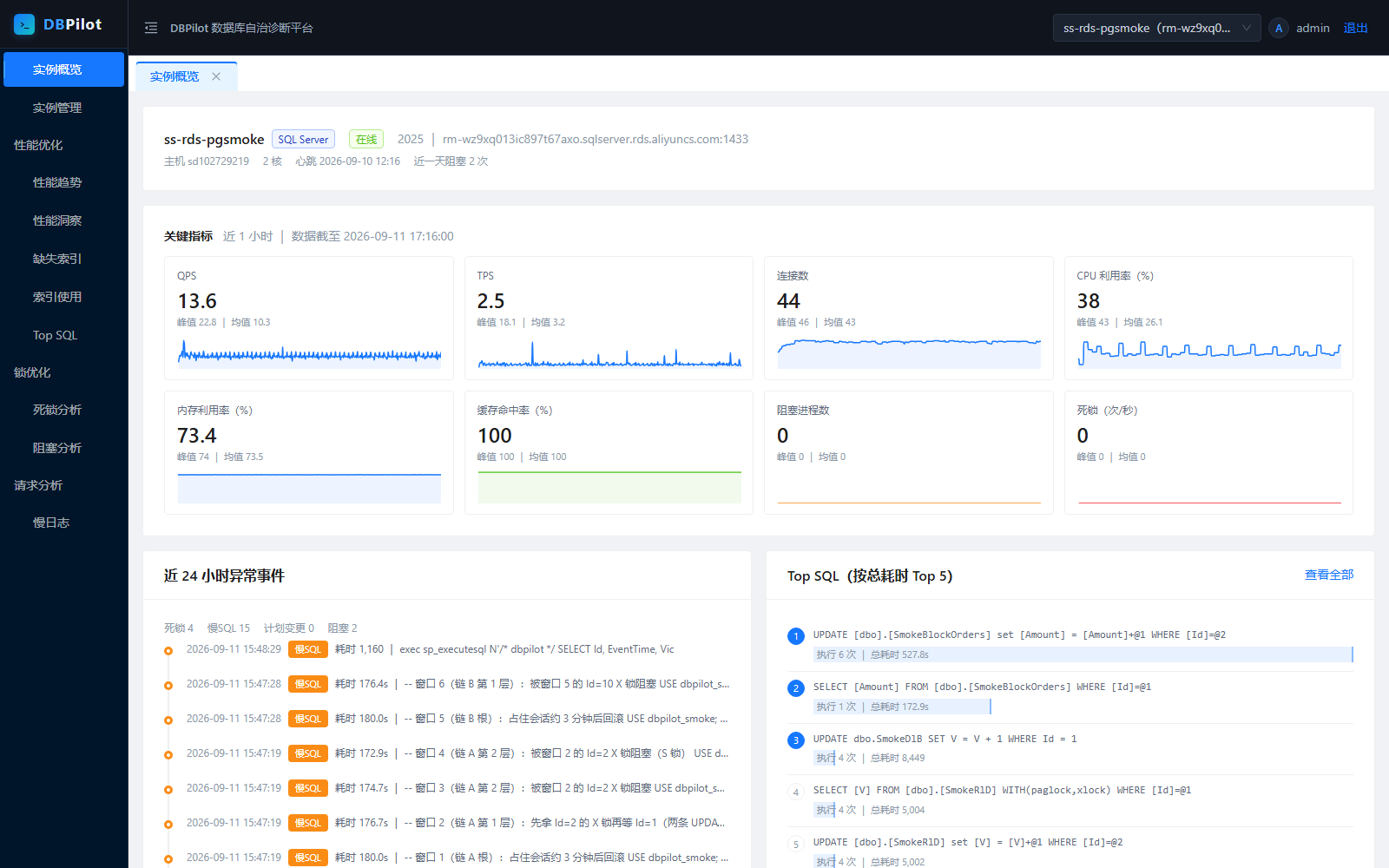
DBPilot continuously samples your instances and serves the day-to-day DBA workflow in one web console: performance trends and insight (AAS load decomposition), Top SQL, query plan change tracking, missing-index advice, index usage & fragmentation, blocking analysis, deadlock analysis, and slow query logs.
Contents
- Highlights
- Screenshots
- Quick start
- Password and master key
- Configuration
- Building from source
- Architecture
- Features
- Engine support matrix
- AI diagnostics (MCP Server)
- Overhead on monitored instances
- Embedding via NuGet
- FAQ
- License
Highlights
- Single-process deployment — one .NET process (8.0+) + one metadata DB, schema auto-created on startup (SQL Server / MySQL / PostgreSQL / SQLite).
- Monitors three engines — SQL Server 2008–2022, MySQL 8.0+, PostgreSQL 13+. Monitoring and metadata-store engines are independent axes: any combination works.
- <1% CPU overhead — collectors read only in-memory metadata views (DMVs /
pg_stat_*/performance_schema); business tables are never scanned. - AI-ready — built-in read-only MCP Server exposes 11 diagnostic tools to AI agents (Claude Code, Codex CLI). Just ask: "did any SQL slow down in the last hour?"
- Capability-driven UI — features without an equivalent data source hide or degrade per engine (PostgreSQL gets deadlock trends instead of event details); APIs answer with actionable messages.
Screenshots
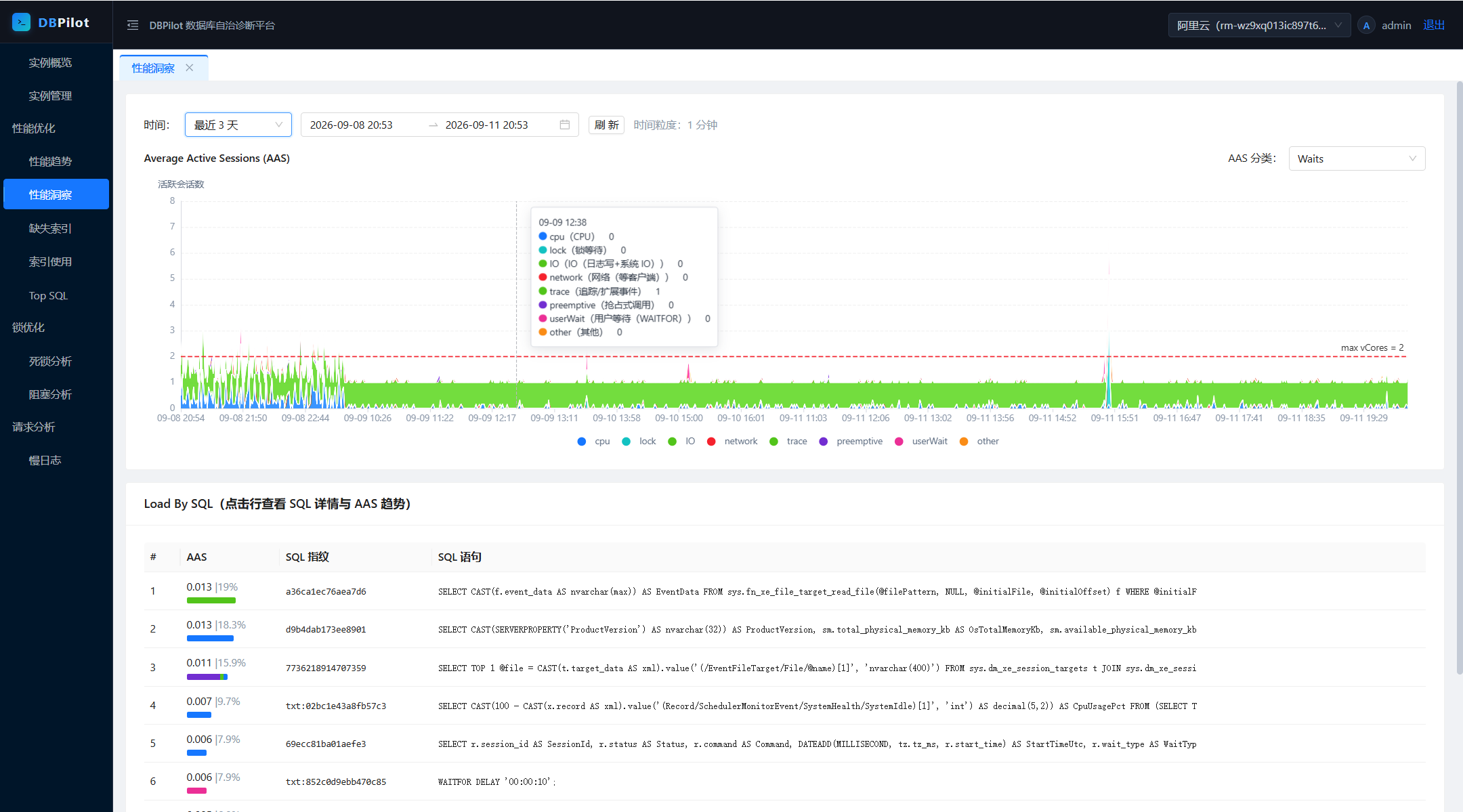
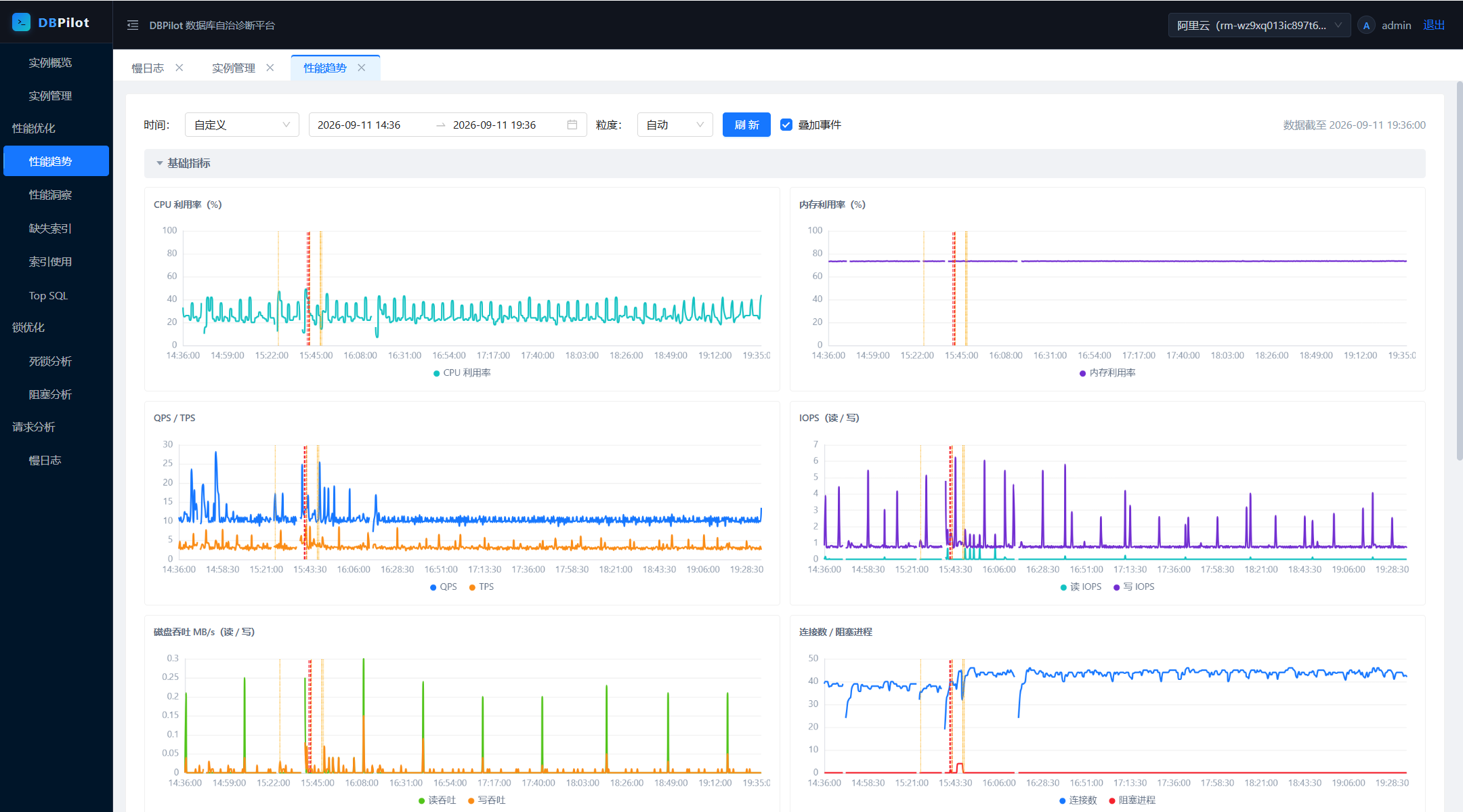
| Performance insight (AAS) | Performance trends |
|---|---|
 |  |
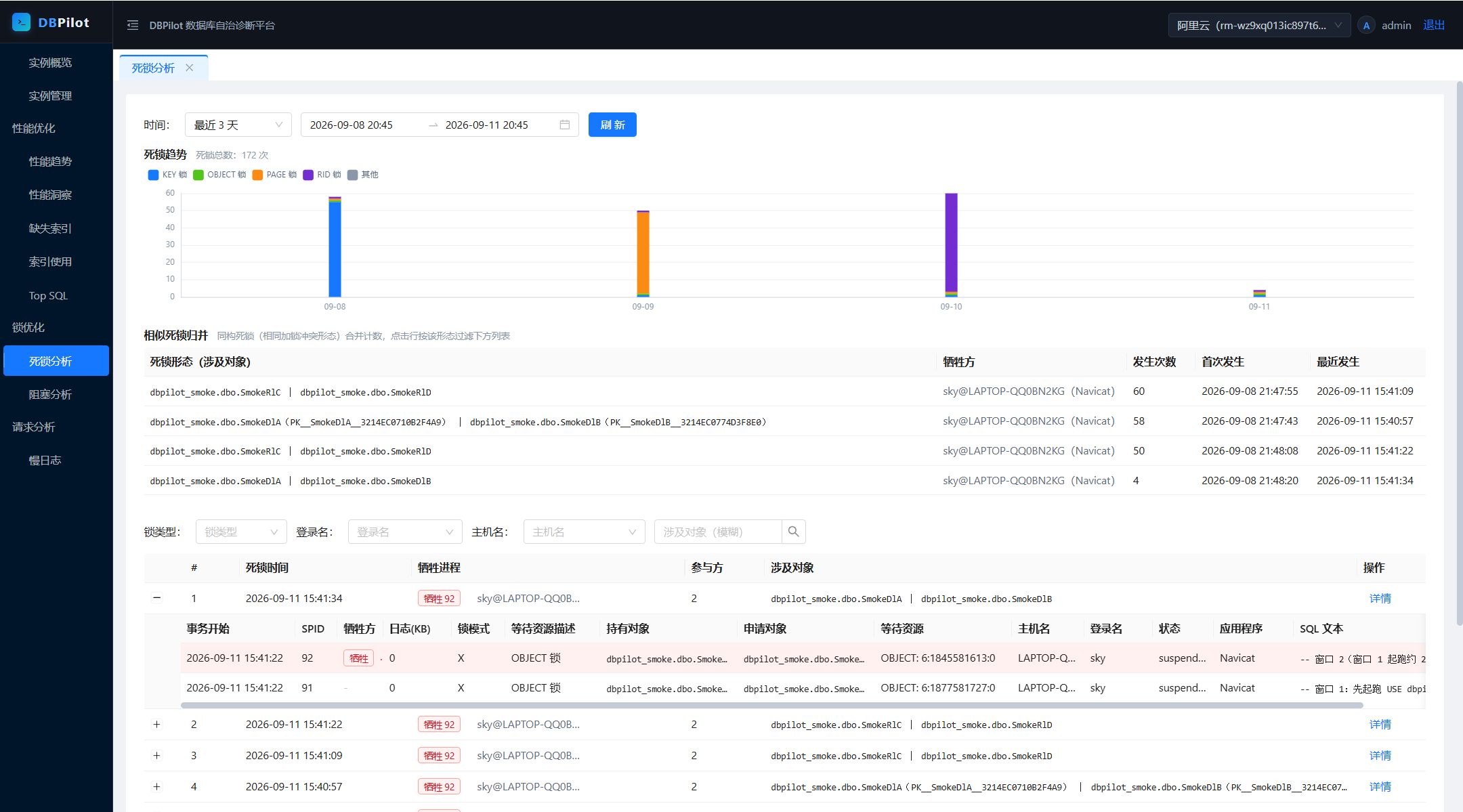
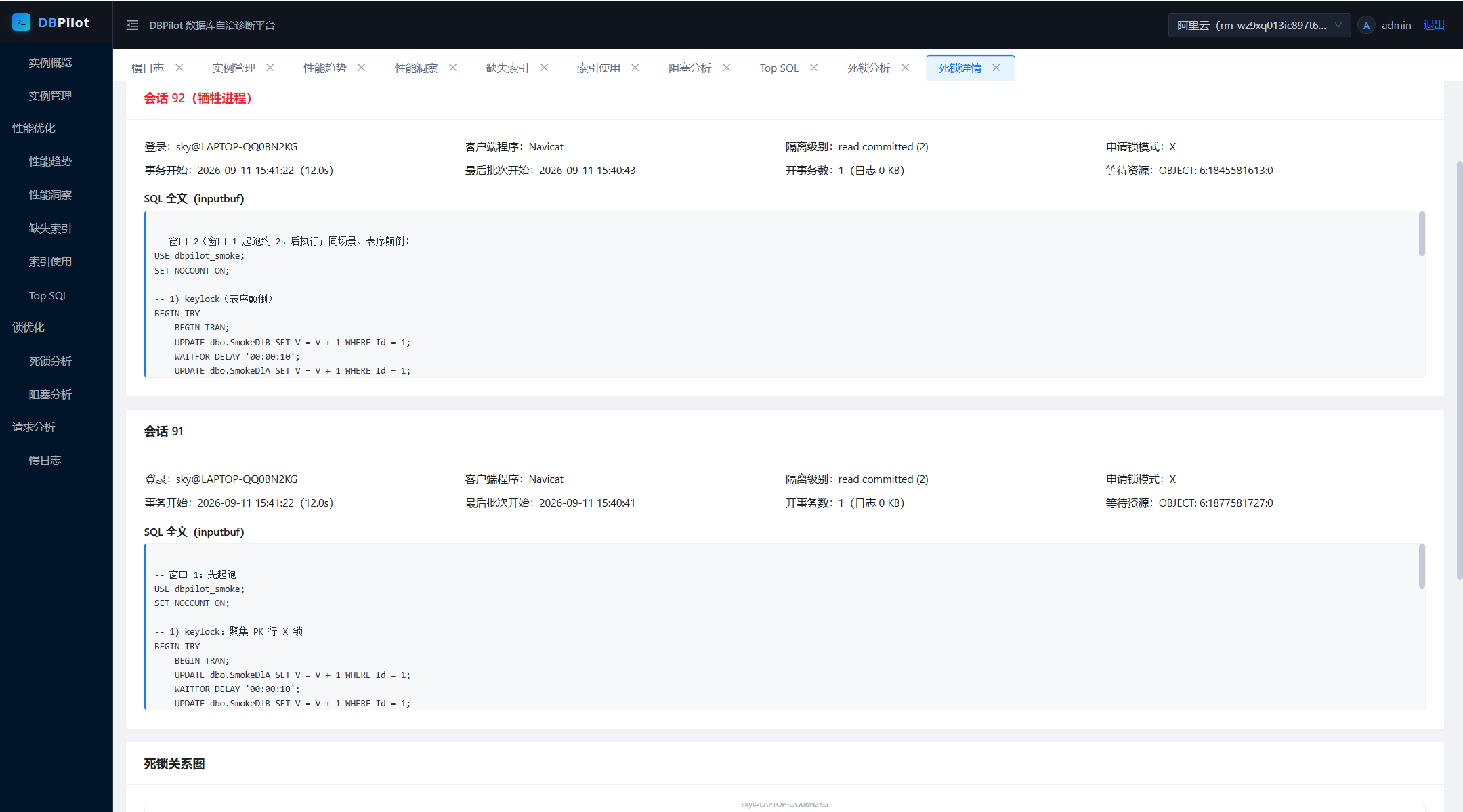
| Deadlock analysis | Deadlock event detail |
|---|---|
 |  |
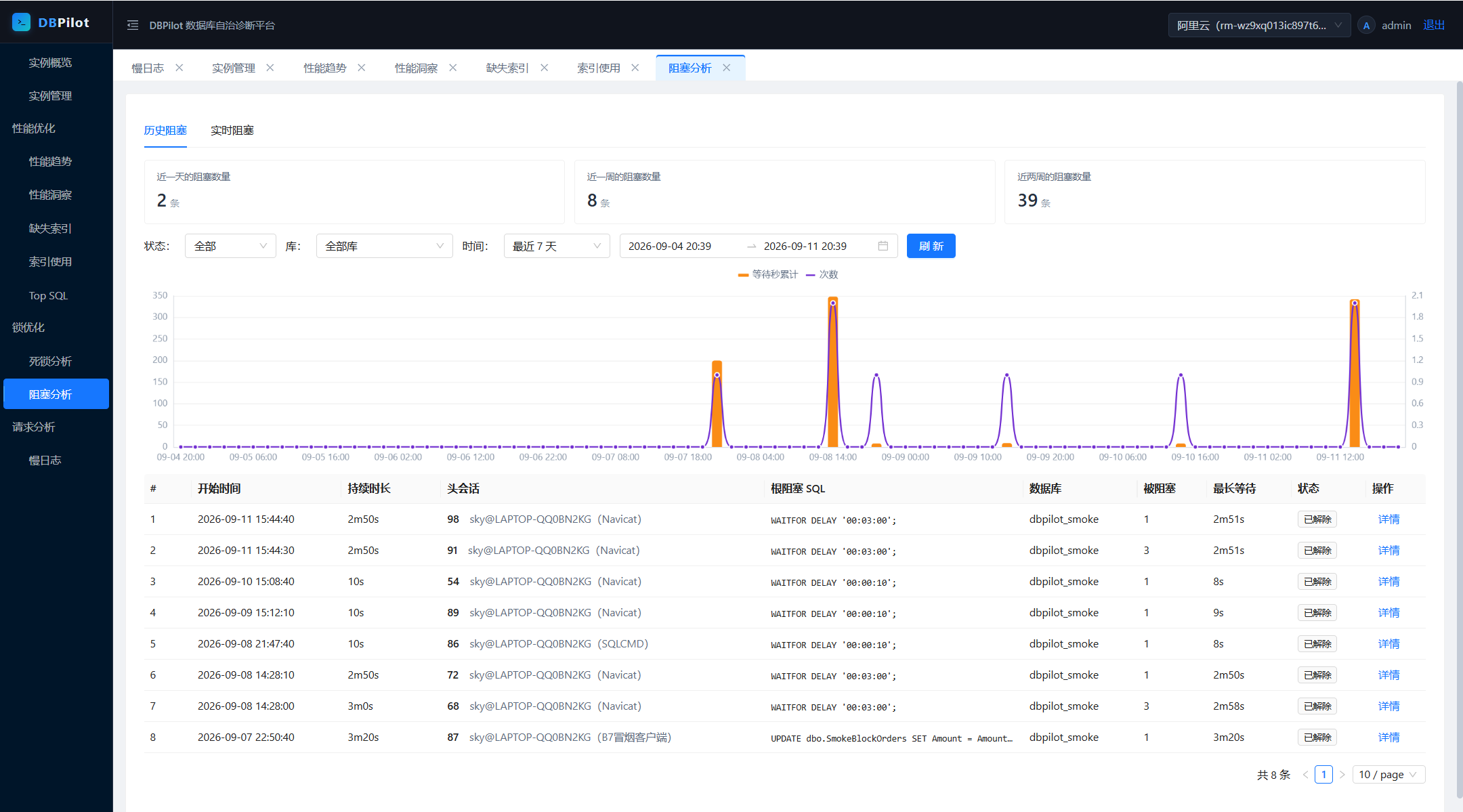
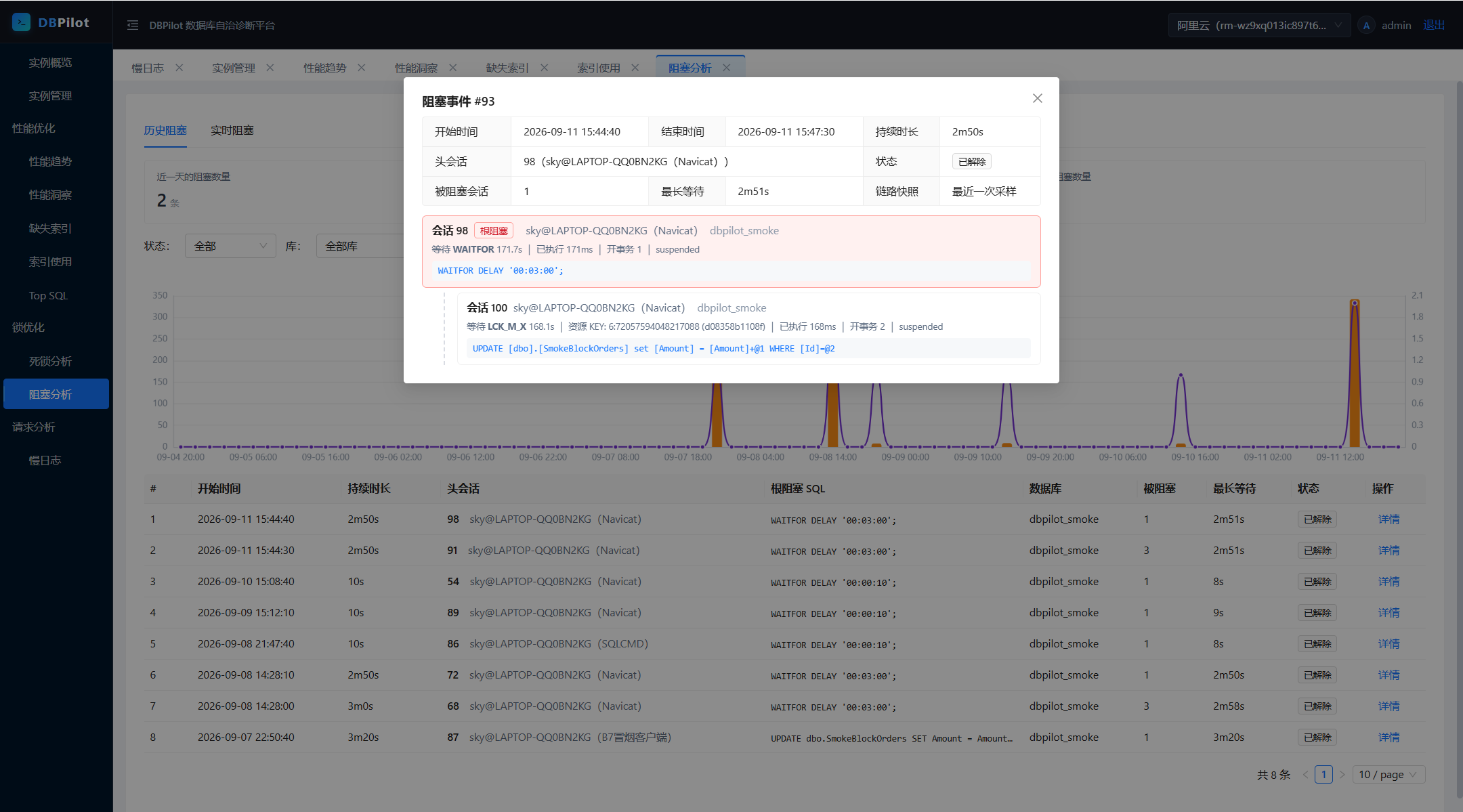
| Blocking analysis | Blocking chain detail |
|---|---|
 |  |
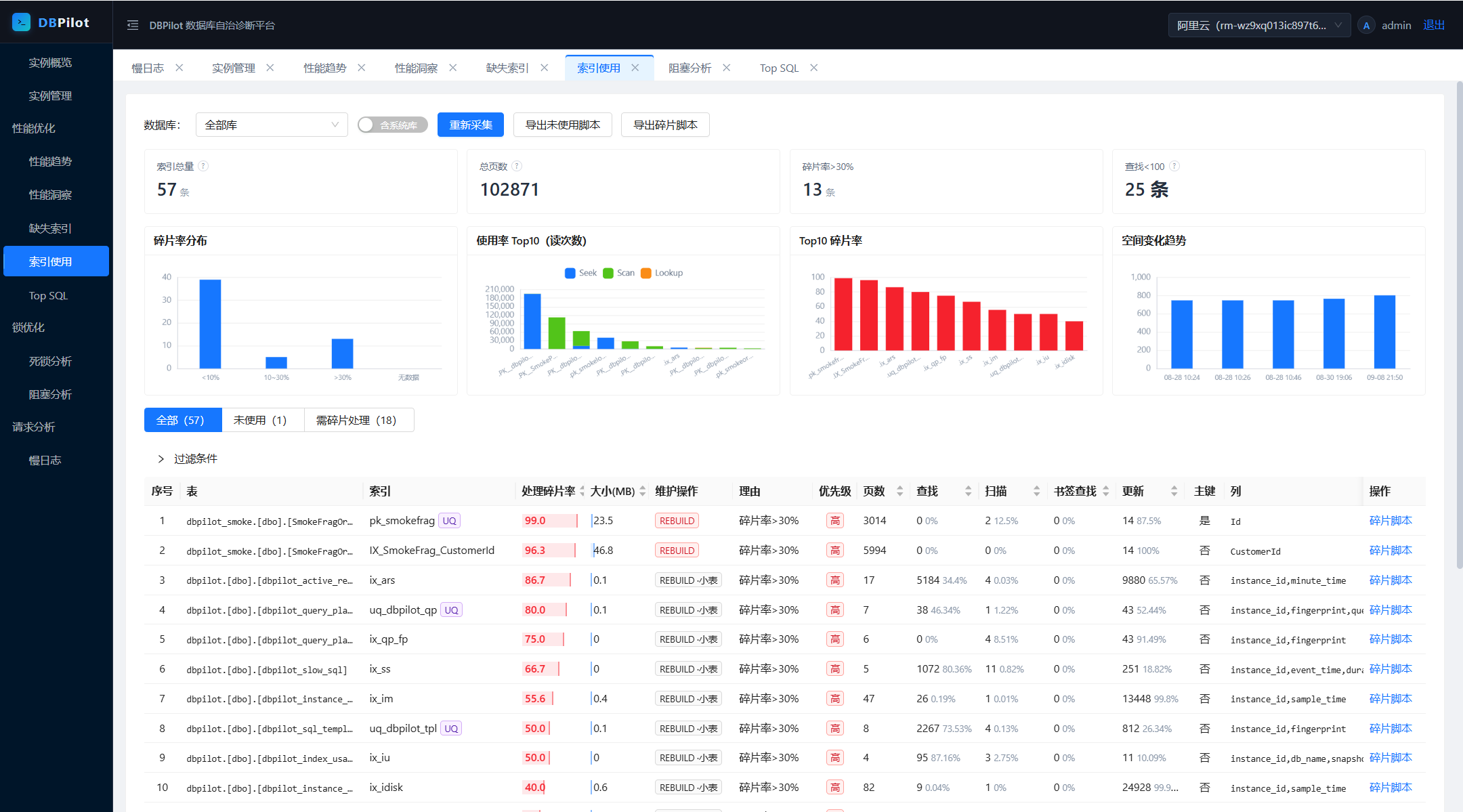
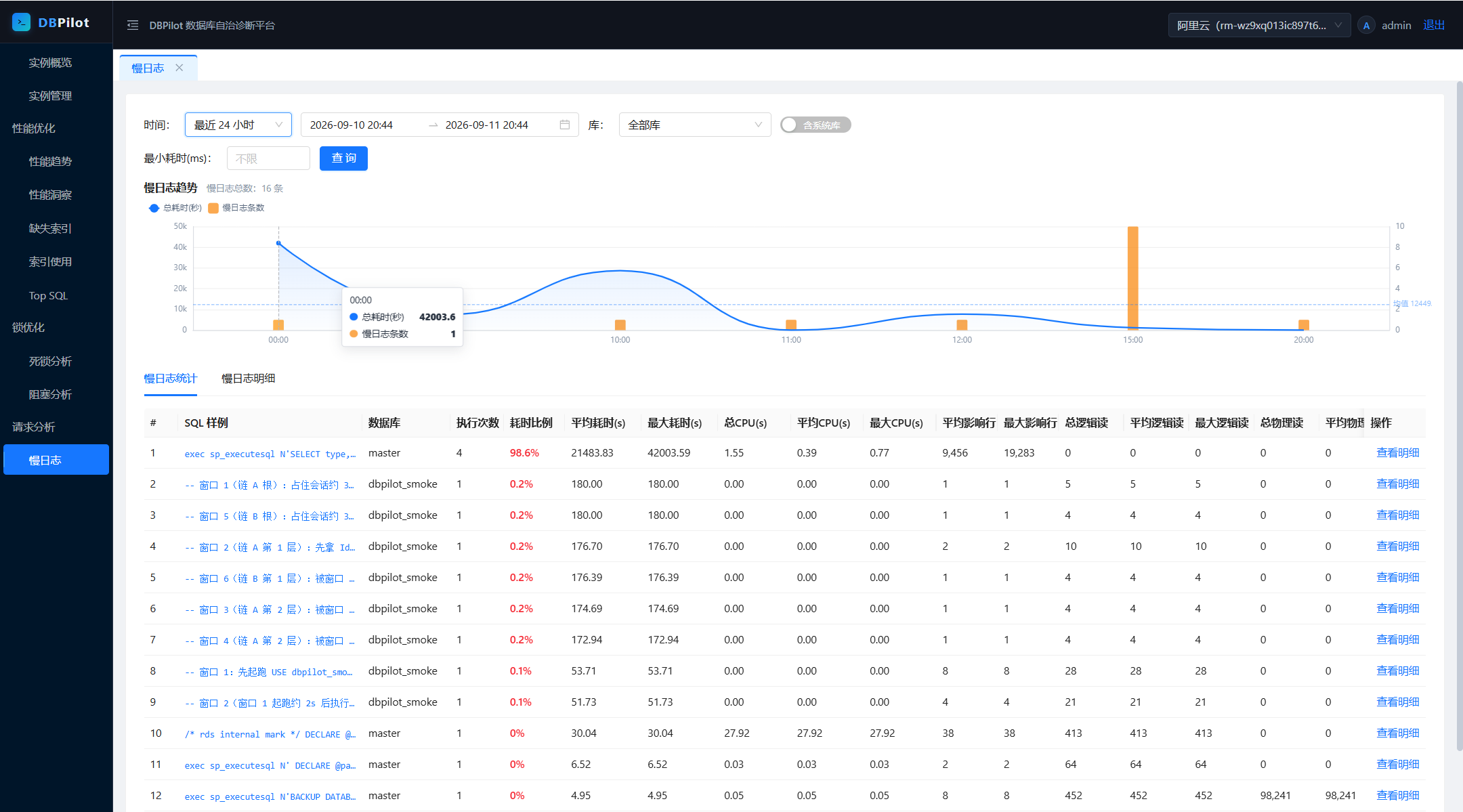
| Index usage | Slow query log |
|---|---|
 |  |
Quick start
Fastest path: NuGet packages (frontend embedded — no Node.js). Requires .NET SDK 8.0+ — packages run on .NET 8 or later.
- Create a host project and add the metapackage:
mkdir dbpilot-demo && cd dbpilot-demo
dotnet new web
dotnet add package DBPilot
Don't name the host project
dbpilotorDBPilot.*— it collides with the NuGet package and restore fails (NU1108).
- Replace
Program.cswith:
using DBPilot.AspNetCore.Extension;
using DBPilot.Core.Providers;

var builder = WebApplication.CreateBuilder(args);
builder.AddDBPilot(o => o.PlatformEngine = DbpilotEngine.Sqlite);  // metadata store: SQLite, zero dependencies

var app = builder.Build();
app.UseDBPilot();
app.Run();
- Replace
appsettings.jsonwith (SQLite flavor):
{
  "Serilog": {
    "MinimumLevel": {
      "Default": "Information",
      "Override": { "Microsoft": "Warning", "System": "Warning" }
    }
  },
  "DBPilot": {
    "ConnectionString": "Data Source=dbpilot_platform.db",
    "Mcp": { "ApiKey": "<random key; non-empty enables MCP, empty = off>" },
    "Auth": {
      "Username": "admin",
      "PasswordHash": "pbkdf2$100000$IOaBWezPYRnzEbBWYwLxZA==$xBWm8jjDfanDmyRttfnZoG4MIk8lcF0UnDbpjJuWaEU=",
      "Secret": "<your master key (>= 32-char random string)>"
    }
  },
  "AllowedHosts": "*"
}
ConnectionStringandAuth:Secretare required — the SQLite file and schema are created on startup; the master key is generated as shown below.PasswordHashis the hash of the default passworddbpilot@2026; keep it to log in with the default.
- Run:
dotnet run # → http://localhost:5000
- Log in with
admin/dbpilot@2026(change it after deployment), then register your first instance: Instances → Add → Test connection → Enable. Real-time pages work immediately; history accumulates.
Metadata store: for SQL Server / MySQL / PostgreSQL, switch PlatformEngine and the connection string — that's all; registered instances are unaffected. SQLite suits evaluation and single-machine use; prefer a server engine for production (and multi-process roles). Ready-made hosts: samples/ (SqlServer :5200 / MySql :5201 / Sqlite :5203 / PostgreSql :5204).
Password and master key
Change the login password: passwords are PBKDF2 hashes in DBPilot:Auth:PasswordHash — replace the hash to change the password.
- Create a two-line
hash.csoutside any project directory (your home dir works). Inside a project,dotnet runwould treat it as an argument. File-based apps with#:packageneed .NET SDK 10; on SDK 8 use the repo-clone alternative below:
#:package DBPilot.Core@0.5.5
Console.WriteLine(DBPilot.Core.Auth.PasswordHasher.Hash(args[0]));
- Run it — the whole output line is the new hash:
dotnet run hash.cs <new-password>
- Paste it into
DBPilot:Auth:PasswordHash, restart.
Repo clones can skip the steps: dotnet run --project samples/DBPilot.Sample.SqlServer -- --hash <new-password>.
Master key (Auth:Secret, or env DBPILOT_MASTER_KEY) — required, exactly two uses:
| Purpose | What it does | If you change it |
|---|---|---|
| Login-cookie signing | issues/validates login tickets (HMAC-SHA256) | all sessions logged out; log in again |
| Instance-credential encryption | instance passwords stored AES-256-GCM-encrypted in the metadata DB | old ciphertext is undecryptable, no recovery — re-enter each instance's password in the UI |
Hence startup fails without it, and you should not change it once in use. Generate one:
openssl rand -base64 32      # Linux / macOS / Git Bash
# PowerShell: [guid]::NewGuid().ToString("N") + [guid]::NewGuid().ToString("N")
Configuration (appsettings.json)
Two required keys + one required value — DBPilot:ConnectionString, DBPilot:PlatformEngine, and a master key (Auth:Secret or env DBPILOT_MASTER_KEY). Missing → startup error; everything else is optional with defaults.
| Key | Required | Notes |
|---|---|---|
DBPilot:ConnectionString | yes | metadata DB connection string; schema auto-created on startup |
DBPilot:PlatformEngine | yes | sqlserver / mysql / postgresql / sqlite; in code: o.PlatformEngine = DbpilotEngine.SqlServer. Independent of which engines you monitor |
DBPilot:Auth:Secret | yes (or env) | master key — signs login cookies, encrypts instance credentials; ≥32-char random string |
DBPILOT_MASTER_KEY (env) | yes (or Secret) | env form of the master key, container-friendly; config value takes precedence |
DBPilot:Auth:Username / PasswordHash | no | login account (default admin) / password hash (default dbpilot@2026) |
DBPilot:Mcp:ApiKey | no | MCP Server switch (non-empty = on) |
DBPilot:Roles | no | process roles (Web / Collector, both by default); multi-process = 1 collector + N web fronts — two collectors on one metadata DB double-collect |
DBPilot:Jobs | no | per-collector switch & cron; empty value = disable that collector |
DBPilot:Retention / DBPilot:Collect | no | retention days (auto-clean) / parallelism & backoff |
DBPilot:AutoInitSchema | no | auto-create schema on startup (default true; set false when DBAs own the schema); versioned incremental migrations (dbpilot_schema_version) run alongside on upgrade |
DBPilot:TopSqlExcludePatterns | no | Top SQL noise filter (LIKE patterns); default set built in, explicit empty array clears it |
Monitored instances are never configured here — they live in the UI, credentials encrypted in the metadata DB.
Building from source
Additionally requires Node.js 20+ (the embedded web UI comes from the frontend build; NuGet packages ship it prebuilt).
git clone https://github.com/SkyChenSky/DBPilot.git
cd DBPilot
scripts\run\setup.bat      # frontend build + compile + sample appsettings.json (default SqlServer host; pass MySql / Sqlite / PostgreSql to switch)
# edit samples/DBPilot.Sample.SqlServer/appsettings.json — fill in the connection string and Auth:Secret
dotnet run --project samples/DBPilot.Sample.SqlServer    # → http://localhost:5200
Non-Windows / manual equivalent:
cd web && npm install && npm run build
cd .. && dotnet build
cp samples/DBPilot.Sample.SqlServer/appsettings.template.json samples/DBPilot.Sample.SqlServer/appsettings.json
Day-to-day dev: scripts\run\dev.bat, or two terminals — dotnet watch --project samples/DBPilot.Sample.SqlServer (backend, Swagger at /swagger) + cd web && npm run dev (frontend → http://localhost:5173). Tests: scripts\run\test.bat (compile + unit tests + frontend build). Self-test load scripts in scripts/test/ — never run them against production databases.
Architecture
flowchart LR
    subgraph browser["Browser"]
        ui["Web console"]
    end

    subgraph host["DBPilot service (single process)"]
        api["Web API + MCP Server"]
        sched["Background collectors (Quartz)"]
        webhost["Static UI hosting"]
    end

    subgraph platform["Metadata DB (schema auto-created)"]
        tables["Historical data"]
    end

    subgraph monitored["Monitored instances (any number)"]
        dmv["DMV / XE / pg_stat_* / performance_schema"]
    end

    ui --> webhost
    ui -->|API| api
    sched -->|scheduled sampling| dmv
    sched --> tables
    api --> tables
    api -->|real-time queries| dmv
The browser talks only to the DBPilot service: real-time pages query instances directly, history pages read the metadata DB — both share the same data conventions (noise exclusion, fingerprinting, time windows).
Features
| Page | What it answers |
|---|---|
| Overview | instance health at a glance — metric cards with sparklines, recent events, Top SQL digest |
| Performance trends | CPU / memory / PLE / QPS·TPS / IO / disk, 10s granularity (30-day retention, auto down-sampling); event overlay for deadlocks / slow SQL / plan changes |
| Performance insight | Average Active Sessions decomposed into CPU / lock / IO / waits — which resource is saturated, and the SQL statements contributing the load |
| Top SQL | real-time leaderboard + history trends, merged by fingerprint; one-click noise exclusion |
| Query plans | plan versions snapshotted automatically; changes raise events with before/after comparison, plan tree and XML |
| Missing indexes | optimizer recommendations ranked by impact, with CREATE scripts and overlap hints |
| Index usage / fragmentation | unused-index detection with drop scripts; fragmentation scan with REBUILD / REORGANIZE scripts |
| Blocking analysis | real-time blocking tree (head blocker, chain, wait times) + historical statistics |
| Deadlock analysis | captured automatically; graph view of the cycle, statements and lock relationships |
| Slow query log | above-threshold statements archived automatically — full text, duration, IO, fingerprint |
Engine support matrix
| Capability | SQL Server | MySQL 8.0+ | PostgreSQL 13+ |
|---|---|---|---|
| Sessions / blocking (real-time tree + history) | ✅ | ✅ | ✅ (pg_stat_activity + pg_blocking_pids) |
| Top SQL (fingerprinted) | ✅ | ✅ (performance_schema digest) | ✅ (pg_stat_statements) |
| Slow query log | ✅ (XE events) | ✅ (mysql.slow_log table) | ◐ template leaderboard |
| Performance trends | ✅ | ◐ (no OS CPU/memory, PLE, compile counters) | ◐ (QPS is transaction-scope) |
| Deadlock analysis | ✅ event details + graph | ❌ | ◐ trend only |
| Query plan snapshots / change tracking | ✅ | ❌ | ❌ |
| Missing index advice | ✅ | ❌ | ❌ |
| Index usage | ✅ | ◐ (unused-index detection conservative) | ◐ (unused indexes reliably detectable) |
| Fragmentation scan | ✅ | ❌ | ❌ |
| Index disable script | ✅ | ✅ (INVISIBLE) | ❌ |
| Disk usage | ✅ volume-level | ◐ database-level | ◐ database-level |
Metadata store: SQL Server / MySQL / PostgreSQL / SQLite — independent from the monitored engines, any combination (SQLite = single-executable + single-file embedded deployment).
Prerequisites are minimal and self-checked by the connection-test wizard: MySQL needs performance_schema + slow-log settings; PostgreSQL needs the pg_stat_statements extension; SQL Server works from 2008 up (deadlock capture rides the built-in system_health session). The wizard tells you exactly what to change when something is missing.
AI diagnostics (MCP Server)
A read-only MCP Server (/mcp, Streamable HTTP + API key) hands the platform's evidence — metrics, slow SQL, deadlocks, blocking, indexes — to AI agents as 11 read-only tools. Agents never connect to your databases directly; every call is audit-logged.
Enable (off by default; non-empty ApiKey = on):
"DBPilot": { "Mcp": { "ApiKey": "a sufficiently random key" } }
claude mcp add --transport http dbpilot http://localhost:5200/mcp --header "X-Api-Key: <your-key>"
Then just ask: "use dbpilot to check the instance load over the last hour — any SQL getting slower?" Add --scope user to make it global.
Codex CLI (~/.codex/config.toml):
[mcp_servers.dbpilot]
url = "http://localhost:5200/mcp"

[mcp_servers.dbpilot.http_headers]
X-Api-Key = "<your-key>"
Example projects live in examples/: DBPilot.McpConsole (command-line diagnostic console) and DBPilot.Scenarios (fault-drill project), both referencing the official NuGet packages.
Overhead on monitored instances
<1% CPU, zero disk pressure. Collectors read in-memory metadata views only — no business-table scans, no physical IO, no locks on user objects.
| Collector | Frequency | Cost |
|---|---|---|
| Sessions / metrics / Top SQL delta / deadlocks / slow SQL | 10–60s | millisecond-level metadata queries; XE cursors near zero when idle |
| Query plan snapshots | 5 min | plan XML fetched once per fingerprint (XML generation is the expensive part) |
| Index snapshots (incl. fragmentation) | daily 03:10 | heaviest tick, scheduled at night |
| History writes | — | always to the metadata DB, never to monitored instances |
Built-in mitigations: XE predicates exclude the platform's own traffic, every cron is configurable, instances disable individually, failed connections back off. Same DMV-polling path as SQL Server's own system_health and AWS Performance Insights.
Verify it yourself — after a day of running, the monitoring account's accumulated CPU seconds is the true cost:
SELECT login_name, SUM(cpu_time)/1000 AS cpu_seconds_total
FROM sys.dm_exec_sessions
WHERE host_process_id IS NOT NULL
GROUP BY login_name;
Embedding via NuGet
Published on nuget.org:
dotnet add package DBPilot            # metapackage: AspNetCore + all engines, one line
# or pick what you need:
dotnet add package DBPilot.AspNetCore # API / MCP / auth / scheduling / embedded frontend
dotnet add package DBPilot.SqlServer  # engines — SqlServer / MySql / PostgreSql (monitor + storage)
dotnet add package DBPilot.MySql      #   and Sqlite (storage only, embedded deployments)
dotnet add package DBPilot.Sqlite
using DBPilot.AspNetCore.Extension;
using DBPilot.Core.Providers;

var builder = WebApplication.CreateBuilder(args);
builder.AddDBPilot(o =>
{
    o.PlatformEngine = DbpilotEngine.SqlServer;  // no default — set explicitly (or via DBPilot:PlatformEngine)
    // o.WebOnly();                               // delegate sets only what you want to change
});

var app = builder.Build();
app.UseDBPilot();
app.Run();
- Zero wiring — referenced engine packages register themselves (output-directory scan); instances route by their
enginecolumn. Explicit registration (AddDbpilotSqlServer()) mixes in and is required for single-file publishes. - Package graph:
DBPilot.AspNetCore → Core → Storage → Common; engine packages depend on Core + Storage. - Frontend assets ship twice —
buildTransitivetargets copy intowwwroot, plus an embedded-manifest fallback so the UI works even with an empty wwwroot. - Fine-grained methods (
AddDbpilotWeb/AddDbpilotMcp/AddDbpilotQuartz/ ...) remain available.
FAQ
| Symptom | Fix |
|---|---|
Startup warning 平台库结构初始化失败 (schema init failed) | check DBPilot:ConnectionString and DB reachability; ignorable without persistence |
| Home page 404 / stale UI | frontend not built — cd web && npm install && npm run build, rebuild, restart |
| Startup error "DBPilot 主密钥未配置" (master key missing) | set DBPilot:Auth:Secret or env DBPILOT_MASTER_KEY |
Collector error The computed authentication tag did not match... | master key doesn't match the stored credential ciphertext (changed after instances were registered) — re-enter each instance's password in the UI |
| Performance insight empty | instance enabled and collecting? Insights need ~1 minute of samples |
| Deadlock / slow SQL events not showing yet | event files buffer ~1 minute — wait and refresh |
License
Collected info
- ★ 75 stars
- ⎇ 16 forks
- Language: C#
- Source updated: 9/24/2026
Config for your environment
Replace {MCP_ENDPOINT_URL} with this MCP’s endpoint URL (from its repo or docs above). No API key — you connect directly.
Tool
OS
Config file: ~/.cursor/mcp.json
{
  "mcpServers": {
    "mcp-server": {
      "url": "{MCP_ENDPOINT_URL}"
    }
  }
}Paste into mcpServers in the config file. Restart Cursor after saving.
If this MCP is also published on mcpchannel.ai, you can subscribe from Browse and use the gateway config there instead.