
pi-posthorse
Posthorse: fresh context, same journey. Native no-summary context windows for the fitchmultz/pi fork of the Pi coding agent, with rollover tools, durable notes, and history recovery.
Links
README
From the repo.
Posthorse
Fresh context. Same journey. (POST-horse)
Native, no-summary context windows for the fitchmultz/pi fork of Pi. A post-horse was swapped in at relay stations so the courier and the message could continue on fresh legs. Posthorse does the same for a model: fresh context, same work, complete recoverable transcript.
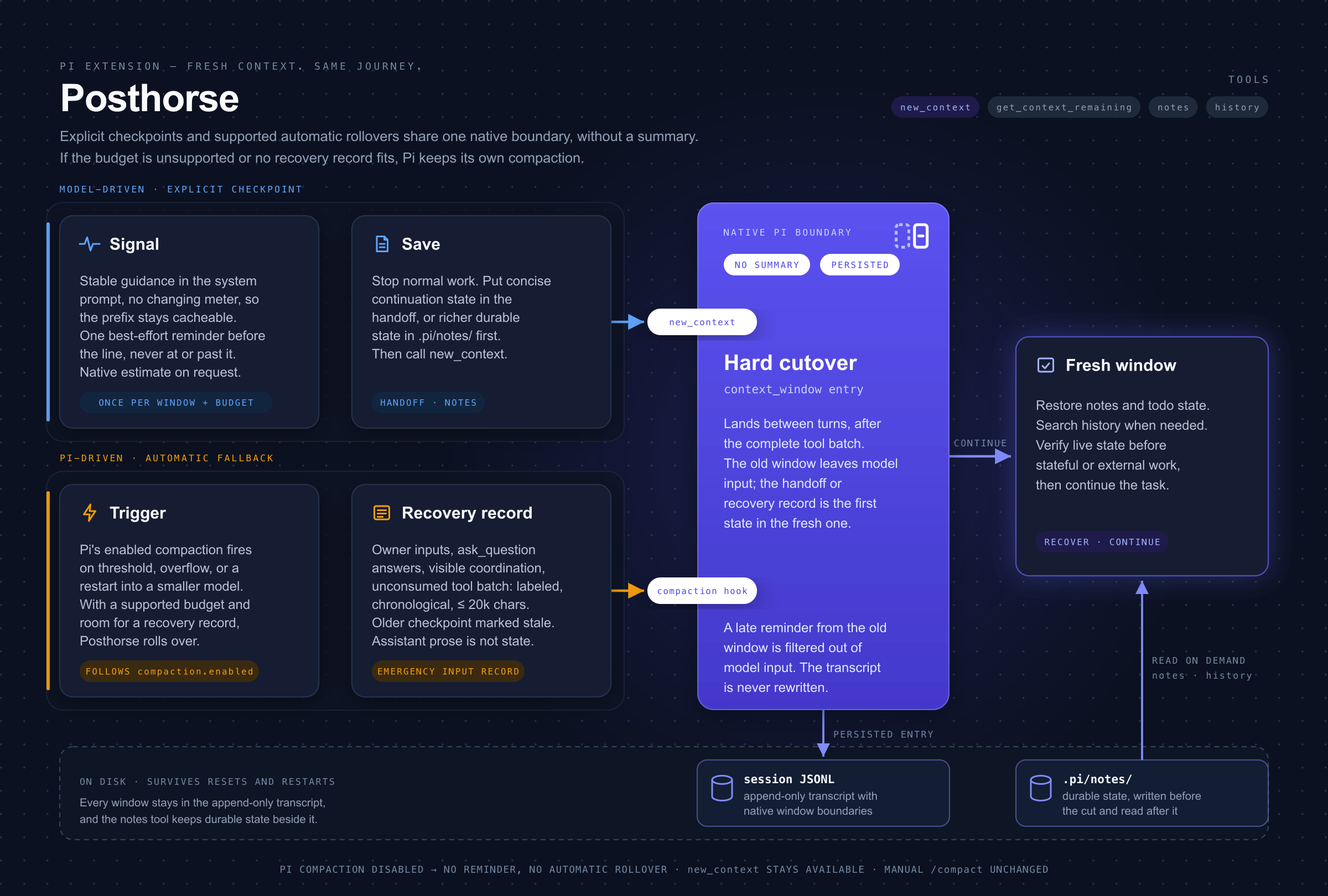
Pi owns the persisted boundary. Posthorse owns the policy: stable window guidance, one best-effort checkpoint reminder, new_context, get_context_remaining, durable notes, and window-aware history. A rollover removes the old window from active model context while the JSONL transcript stays append-only and complete.
An isolated Codex prototype tests local notes and recovery with Codex's native context reset. It is not ready for everyday use and is not included in the Pi package.
Requirements
- Node
>=22.19.0. - The
fitchmultz/pifork with nativecontext_windowentries,session_before_auto_compact,registerContextWindowHook,ctx.getCompactionSettings(), and the coding-agent SDK'spublishLocalFileexport. - Official, unpatched Pi is unsupported. Posthorse reports a clear error at session start and cannot operate; Pi itself keeps running.
Qualified against fork commit 38b2a5816e030a4ff57379b6db1b882fe8110022. CI uses this exact revision.
Install
Build the fork:
git clone https://github.com/fitchmultz/pi.git
cd pi
npm install --ignore-scripts
npm run build
After updating the fork, run the install and build commands again, then restart Pi. pi --version reads the checkout's package metadata, so it does not prove that the updated source has been built.
Run it as node packages/coding-agent/dist/bundle/cli.js, or run npm link inside packages/coding-agent so that build becomes your pi command.
Then install Posthorse with that pi:
pi install git:github.com/fitchmultz/pi-posthorse        # from Git; add @<tag> to pin a release
pi install npm:pi-posthorse                             # from npm
pi -e git:github.com/fitchmultz/pi-posthorse              # try it for one run without installing
Update with pi update npm:pi-posthorse or pi update --extensions; move a pinned Git install with pi install git:github.com/fitchmultz/pi-posthorse@<new tag>. Uninstall with pi remove npm:pi-posthorse (or the Git source you installed). Removing the package leaves .pi/notes and Pi's session history in place.
Restart Pi after installing or updating Posthorse to load the new extension code.
Keep exactly one copy loaded. pi list shows every package source; if an older entry such as git:github.com/fitchmultz/pi-headroom.git or a local checkout is still listed, pi remove it before installing the npm package, otherwise two copies register the same tools and compete for the same rollover hook.
How it works
- Stable guidance. Window behavior lives in a native system-prompt section. There is no per-request meter. Posthorse preserves custom prompts and falls back to appending guidance when an earlier extension replaces the full prompt; that compatibility path can prevent Pi from preserving an additive prompt prefix.
- One best-effort checkpoint. While Pi compaction is enabled, one reminder may appear shortly before Pi's rollover line. A large turn, overflow, restart, or smaller model can reach rollover without it. Reminders are fingerprinted by window, context size, and reserve, so switching to a different context size gets a fresh reminder. Stale reminders and reminders left after disabling compaction are filtered from model input while remaining in history.
get_context_remaining. Reports the best available native estimate of tokens until Pi's automatic rollover line and until the configured context limit. That configured limit is not a measured provider rejection boundary. Pi's value is an estimate until the active model reports usage.new_context. Requests an atomic rollover after the current foreground (synchronous) tools succeed. An optional handoff is persisted and becomes the first state of the fresh window. A failed synchronous checkpoint save or other foreground sibling prevents Pi from committing the boundary; the checkpoint reminder still applies. Native asynchronous background calls continue across the reset without delaying it. Pi preserves their call provenance and delivers their results in the fresh context.- Automatic rollover without summaries. With a supported context budget and room for a recovery record, Posthorse claims Pi's automatic threshold and overflow trigger through
session_before_auto_compact, before Pi resolves summarization credentials or prepares a summary. Oversized first turns and tool results can then roll over even without summarization credentials. Native asynchronous background calls can remain in progress across automatic rollover too. When a recovery record cannot fit but Pi will retain native receipts in the next window, Posthorse claims a window without a handoff so Pi can prepare and bound those receipts or refuse the window. Already-consumed receipts do not trigger an empty rollover. Otherwise Pi's own compaction remains in control. Manual/compactis unchanged. - Bounded recovery record. The automatic handoff keeps direct user inputs,
ask_questionoutcomes, visible coordination messages, and tool result evidence: tool names and namespaces, call ids, requested and admitted execution arguments when available, bounded result text, and entry ids to recover the rest. Native async results from the current projected window remain eligible even across later complete assistant responses, since a result can arrive during a response that never received it. A result Pi still projects is also eligible when its call was edited out or predates the window, without attributing it to another call. These results may already have been received or handled; they are not proof of current progress. Synchronous results with projected call provenance are kept only from the trailing batch without a later complete response. Pi context edits also apply to these inputs and results: omitted entries stay out, and replacements supersede their original content. A clearly labeled, possibly stale older checkpoint comes last. Older assistant prose is not treated as current state. Newly submitted input stays separate and is saved after the boundary, not copied into the handoff. notesandhistory. Notes are shared across linked worktrees, at the main checkout for conventional Git layouts or inside the common Git directory when metadata is stored separately. History searches normalized transcript text and returns stored images for a requested entry. Tool calls and results retain names, namespaces, and call ids; admitted execution arguments are labeled separately from requested arguments when present. When a handoff carries edited content, its entry ID points to the replacement;history readof that ID returns the replacement text or images. Reading the original entry ID still returns the raw journal content.
Before each fresh window becomes active, Posthorse bounds oversized retained native receipts through append-only context edits. It shares the available capacity across all receipts after accounting for the prompt, tools, pending input, handoff, carried calls, Pi's configured reserve when automatic rollover is enabled and supported, and a safety margin. Pi separately clamps each provider request's output limit to its remaining context capacity. When receipts need shortening, excerpts use half the remaining capacity so the next response has working room. Excerpts retain the native call/result identity and error state, with history read references for complete recovery, including images. Existing replacements remain the recovery source across later windows; raw pre-edit content is never used for a new excerpt. Already-fitting receipts stay unchanged. If fixed input and recovery references cannot fit, rollover fails visibly without publishing a window marker or any proposed edits. Later prompts retry preparation against the unchanged window; correcting the configuration allows ordinary rollover to proceed. Pi independently refuses estimated native transcript input that exceeds physical context capacity, including when compaction is disabled. Its output clamp still permits fitting requests with reduced output, even above the compaction reserve line. Raw wire replacements through onPayload / before_provider_request and custom transport implementations retain responsibility for their own request sizing.
At turn end, Posthorse checks whether usage is in the reminder band before explicitly looking up the full branch. Context filtering skips its branch lookup when model input contains neither posthorse-reminder nor legacy headroom-reminder messages. Complete history remains available through paged searches and reads.
Automatic recovery is an emergency input record, not proof of progress. The fresh model is told to restore notes and todo state, inspect history when needed, and verify live state before taking stateful or external action.
Settings
Posthorse follows Pi's effective compaction settings, including Pi's decision about whether project settings are trusted. Disabling compaction.enabled disables reminders and automatic rollover; new_context stays available.
The model's context window minus compaction.reserveTokens must leave at least 10,000 usable tokens. Below that (for example an 8K or 16K model with the default 16,384 reserve) Posthorse reports an unsupported configuration in the guidance and in get_context_remaining, turns automatic behavior off for that model, and leaves Pi's own compaction in place. Lower the reserve or use a larger model. The checkpoint reminder band is the last 10% of usable context, capped at 32,000 tokens, so a large reserve cannot trigger a reminder immediately in a fresh window.
Explicit and automatic handoffs are capped at 20,000 characters and half the active model's fresh operational capacity after prompt/tool overhead and any pending input, whichever is smaller. Oversized explicit handoffs are rejected with an instruction to save fuller state in notes; automatic rollover stays with Pi when no safe recovery record fits and no native receipts require fresh-window preparation. When usage is not known yet, notes and history pages use the same model-aware limit.
Only one automatic compaction or rollover policy extension should be enabled at a time. Pi keeps the last non-cancel result from multiple handlers of the same hook, so load order would otherwise decide which policy wins.
Tools
new_context({ handoff? })get_context_remaining()notes({ op, ... }):list,read, andsearchare paged; continue with the returned characteroffset. Search excerpts center on the match.writereplaces content (empty content clears);appendadds one newline-terminated record.history({ op, ... }):searchcontinues with the returnedcursorand the samequeryandallscope;limitis the maximum results per page.readpages text and stored images; continue with the returned characteroffsetandimageOffset. An image-only continuation can use anoffsetequal to the text length. If a page needs fresh context, retry with both offsets unchanged. Results keep native entry and window ids.
In the TUI, tools use Pi's native expandable cards. Collapsed cards show the operation and target, a short content preview, and counts or page ranges with the next offset when more remains. Expand with Pi's tool-output shortcut (Ctrl+O by default), or click the card's header or body in fullscreen mode. Expanded cards show the complete returned page and its metadata, not content the tool has not fetched yet. Writes and context requests also show the submitted content or handoff.
Committed context-window messages and checkpoint reminders are compact, expandable cards too. The new_context tool card describes a request; only the committed context-window message says a fresh window has started.
Notes list/search and history search share the remaining context budget with read pages and returned images. Search/list headers, continuation text, no-match responses, and parallel sibling results count toward that budget; pages already counted by Pi are not counted twice. Before usage is known, pages reserve prompt/tool overhead and leave half the rest free. Unsafe pages are refused with the offset or cursor preserved in the call; call new_context and retry. Refusal text uses the same budget, so later failures omit repeated guidance once no more fits.
history search puts matching original content before recovery material: handoffs, compaction and branch summaries, checkpoint reminders, and notes, new_context, and history calls/results. Ordinary prose or another tool call in the same assistant entry keeps its priority when that content matches. Every entry remains searchable; history read returns the complete normalized entry, including any recovery content omitted from a search excerpt.
Within each group, current-branch matches are newest first. With all: true, Posthorse searches session files in the active Pi session directory whose saved working directory matches the current one, along with their nested subagent sessions and the selected current session file when it is in that directory. Files without a valid session header or an attributable working directory are excluded; the active branch remains available. Within that scope, sessions are ordered newest-modified first and entries newest first; this is not a global timestamp sort. All-session hits use a file-qualified ID (native-id@file-key); pass the complete ID to history read. The source file is shown beside each hit, while its fixed-size key keeps cursors usable for nested session paths. The per-page result limit applies after priority, so newer echoes cannot displace older original matches. Each included session file contributes its own matches, including fork copies, so unrelated entries sharing a native ID are never hidden. Search cursors advance past the previous entry, including partial headers or excerpts, so appending lookup calls and results does not keep pagination alive forever. Searches are live: external session edits or file reordering can change results; start a new search to include newer sources.
Notes live in .pi/notes/ at the main checkout for conventional Git layouts, or the current directory outside Git. When Git metadata is stored separately, including in submodules, all checkouts use .pi/notes/ inside Git's common directory instead; no configuration is needed. If that metadata is unavailable, notes stay local to the checkout. Old checkout-local notes are imported when that checkout is accessed, without overwriting shared files or deleting the originals. Writes report the actual storage path. Add .pi/notes/ to .gitignore when the project should not track it.
write uses Pi's native complete-file replacement: a failed write before publication leaves the previous note intact. It follows symlink targets and preserves ordinary permissions and ownership, or fails before publication. Hardlink aliases and already-open handles keep the previous file; ACLs, extended attributes, and power-loss durability are not guaranteed. Full replacements do not merge concurrent appends or other replacements. append retains one O_APPEND write per newline-terminated record.
Data and privacy
- Posthorse makes no network requests.
- Notes are plaintext files under
.pi/notes. They survive package removal and may be committed unless ignored. historywithall: truescans project-matching JSONL files and their nested subagent sessions in the active Pi session directory, not unrelated projects that share that directory.- History can return user text, assistant text and thinking, assistant failure status and error messages, tool arguments and results, handoffs, custom messages, and images. Direct shell entries Pi marked
excludeFromContextcome back as a placeholder only. - Returned history content enters the currently selected model and provider context.
- Removing Posthorse does not remove notes or Pi session history.
Compatibility
Reminders persisted by pi-headroom (headroom-reminder) are recognized alongside posthorse-reminder for deduplication, filtering, and recovery records. Notes, tool names, .pi/notes, and Pi's context_window entries are unchanged.
Develop
npm ci --ignore-scripts
npm run check  # public npm declarations can check types, but cannot run Posthorse
# After the compatibility runner installs the selected fork SDK/types cohort:
PI_COMPAT_HOST=fork npm run check:compat
PI_FORK=../pi scripts/integration.sh   # additional full source-harness integration (disposable fork built)
npm run check type-checks the extension, renderers, and tests against the exact 0.87.0 npm declaration baseline. Runtime tests require the qualified fork SDK, including publishLocalFile, installed in this checkout's dependency graph. npm test covers reminder policy, notes/history behavior, failed note replacement, and real native card components, including width, expansion, and legacy results. Tests use the public SDK entry; official Pi is not an operating target.
check:compat adds test:native: real SDK loading, prompt composition, mixed recovery-output budgets, cursor progress, reminder filtering, interrupted-response recovery, oversized-result rollover without summary compaction, explicit new_context, and checkpoint restore without provider replay. It requires native fork capabilities; it never substitutes synthetic windows or silently skips on official. The runner must install the fork cohort in this checkout's node_modules so both tsc and SDK imports resolve that graph. PI_HOST_INDEX and PI_COMPAT_EXPECTED_PACKAGE_DIR are verified against it, and PI_COMPAT_EXPECTED_VERSION verifies the version. A same-version official graph is not a fork. Official qualification is a separate actual CLI startup/refusal probe, not check:compat.
For a focused read-only SDK diagnostic only, PI_HOST_INDEX=/absolute/fork/dist/index.js node --test test/native.test.mjs can inspect an immutable host; this does not qualify this checkout's types. The larger source integration suite remains available through scripts/integration.sh; use a disposable built fork checkout because it briefly copies a test into that host. All native fixtures must use an isolated HOME/agent directory with offline mode and no provider credentials. These checks do not claim native Windows support.
Collected info
- ★ 247 stars
- ⎇ 7 forks
- Language: TypeScript
- Source updated: 9/23/2026
Config for your environment
Replace {MCP_ENDPOINT_URL} with this MCP’s endpoint URL (from its repo or docs above). No API key — you connect directly.
Tool
OS
Config file: ~/.cursor/mcp.json
{
  "mcpServers": {
    "mcp-server": {
      "url": "{MCP_ENDPOINT_URL}"
    }
  }
}Paste into mcpServers in the config file. Restart Cursor after saving.
If this MCP is also published on mcpchannel.ai, you can subscribe from Browse and use the gateway config there instead.